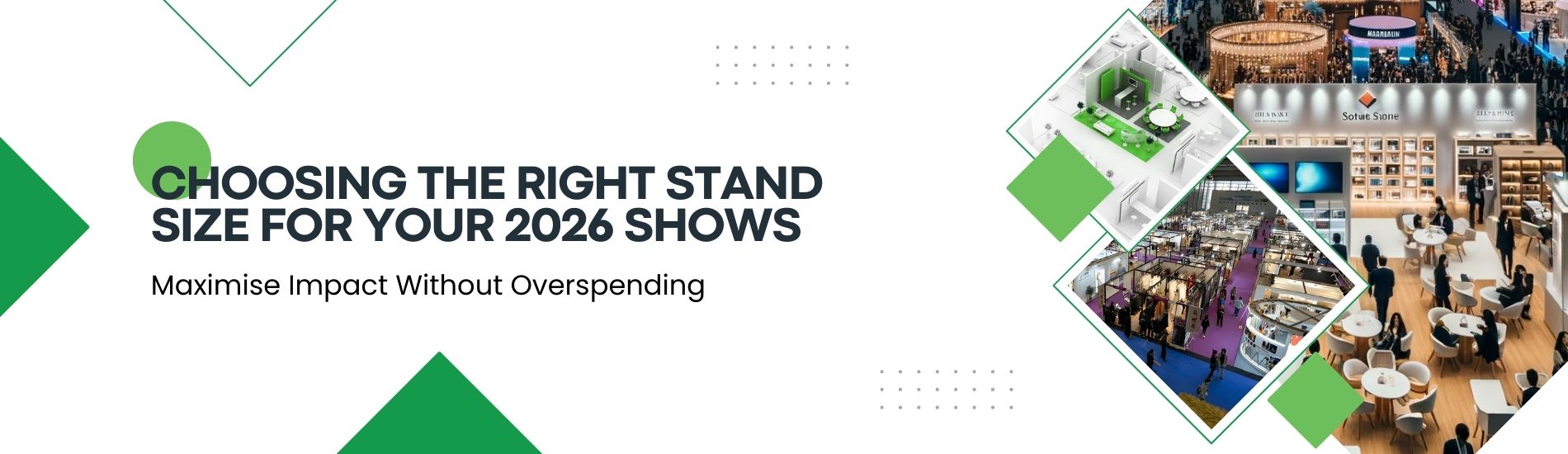
Choosing the Right Stand Size for Your 2026 Shows
Exhibitions are one of the few marketing media that allow the buyer to walk into your brand environment. This, however, comes at a cost. With the rising investment in venue and floor space, as identified by the Centre for Exhibition Industry Research, the decision on the size of your stand for your 2026 show is no longer just a design consideration; it has become a commercial decision.
Exhibitors often choose stands based on how good the space looks on the floor plan. Larger stands look more dominant, while smaller stands look more cost-effective. In reality, the size of your stand depends only on your objectives. The most effective exhibitors are not necessarily the ones with the biggest presence, but the ones who align their space with what they want to achieve at the show.
Start With Commercial Objectives
Before considering layouts or square meters, it is essential that you define your goal. Stand sizes should be aligned with your strategy.
If your goal is a specific form of lead generation, a smaller stand might be a very powerful tool. Smaller stands force more real conversations and ensure that your staff isn’t spread too thin.
If your goal is more along the lines of product demonstrations, or perhaps you need space for pre-scheduled client meetings, you might need more space. The key, however, is clarity. The space should be designed to support performance rather than perception.
If your goal is vague, it is very easy to get caught up in overspending. However, when your goal is clear, it is much easier to justify your stand sizes.
Understand the True Cost of Space
Rental fees are just the starting point. Industry data, as compiled by CEIR, reveals that exhibition expenditure far surpasses the square footage.
A larger stand means:
- Higher build and fabrication costs
- Higher lighting and audiovisual needs
- More expensive graphics creation
- More staff and hospitality bills to pay
- Logistical complexities in installation and dismantle
Rather than focusing on total spend, consider calculating the cost of each lead or each meeting. Does a small, efficient, and highly productive stand really generate a lesser ROI than a visually impressive, yet underperforming, larger space?
Visitor Flow and Layout Efficiency
The square footage, however, is just a starting point. The key is how that space is utilised.
Each booth should have visitor flow in mind. The entry should be easily identifiable. Products should not be placed in a way that they interfere with conversations. Meeting spaces should be accessible, yet not in a way that they expose those in them.
One 24 square meter booth, when utilised correctly, will perform better than a 60 square meter booth that has not been zoned correctly. The visitor will pick up on a space that is confusing or uninviting, regardless of its square footage.
Instead of starting with “how much space do we need,” the better question is “what needs to happen inside the booth.” Once that is clear, the right amount of space becomes a result of the plan, not the starting point.
Align Stand Size With Team Capacity
Your team is the measure of how well the stand is functioning. A large footprint with a small staff makes the stand less effective.
Practical questions to ask:
- How many members of your team are planning on attending?
- Can your team handle the volume of attendees at the exhibition?
- Are any scheduled meetings included within your strategy?
- Are breaks included within your strategy?
If your team is unable to handle multiple engagements at once, a large footprint could actually hurt the quality of service instead of enhancing it.
Brand Positioning and Competitive Context
While the size of stands can impact perception, particularly in a competitive environment, it is not as significant as the placement.
When considering the layout of the floor plan, it is important to consider proximity to entrances, main walkways, and direct competitors. A strategically placed mid-sized stand can far outperform a larger stand located in a secondary walkway.
What visitors will remember are the message, the confidence of the team, and the quality of interaction, not the actual size of the stands. Scale should follow strategy..
Product Complexity and Demonstration Needs
Your type of product will play a significant role in determining your spatial needs.
If you are a company displaying machinery or equipment, you will need to consider safety clearance and demonstration space.
In many instances, space requirements depend on:
- Size of products to be displayed
- Requirement for live demonstrations
- Areas for gathering audiences
- Storage of materials and equipment
For 2026, modular systems are a consideration to allow expansion in flagship shows and contraction in regional shows without starting from scratch, thus protecting future budgets without compromising brand identity.
Operational Gaps That Undermine Sustainability in 2026
The majority of stands do not meet their sustainability goals in 2026 not due to the materials used, but due to inefficient operational design.
Storage is often an overlooked feature. The consequence is apparent disorder, disorganization of workflows, and emergency measures that depend on disposable items.
This does not just affect appearance. It creates inefficiencies on-site, increases material dependency during the event, and limits how well a stand can be reused later.
Even compact stands now require integrated storage. Larger builds must separate operational zones without interrupting visitor movement. Because in 2026, sustainability is not only about what is built. It is about how well it performs during the event.
Plan Across Your 2026 Exhibition Calendar
If you are attending multiple shows, it might be wise to avoid making isolated decisions.
Consider the following types of shows:
- Flagship industry exhibitions
- Regional market activations
- Relationship-driven trade shows
- New market entry shows
Not all shows require the same investment. Flagship shows might require larger stands for increased exposure and competitive positioning.
Consistency in branding, with flexibility in stand size, can allow for better resource allocation.
Final Thoughts
Choosing the proper stand size in 2026, in any case, is all about finding a balance between scale and responsibility. What gets measured, gets achieved and the proper stand size will be the one that matches company objectives, team capacity, visitor flow, product display, and ROI. Every square meter must serve a purpose, and every step taken should reflect a certain objective of the business.
The question is whether your choices for the 2026 stand are in line with results or just expectations?
Latest Blogs


© Copyright by FOUNTAINHEAD INTERNATIONAL B.V. || Designed and maintained by S2code