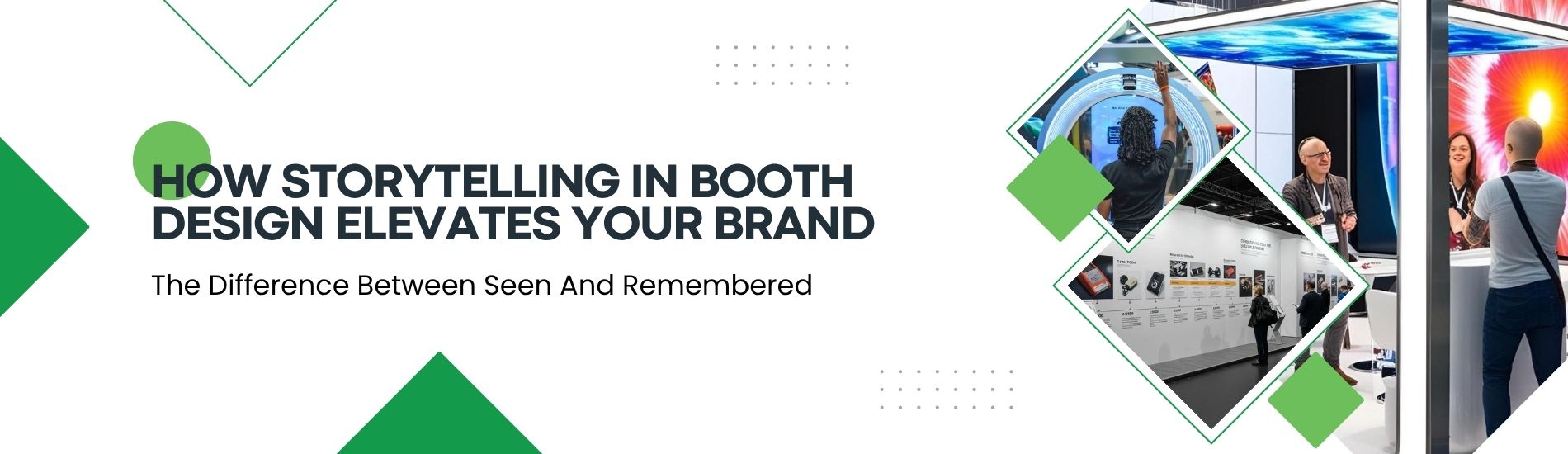
How Storytelling in Booth Design Elevates Your Brand
How Storytelling in Booth Design Elevates Your Brand in 2026
The Difference Between Seen And Remembered
By the end of a trade show, most people don’t recall the booths they visited. What they recall is a handful of brands. Not the ones that had the biggest screens or the most products on display, but the ones that made immediate sense.
This is the role that storytelling is starting to take in the design of a booth in 2026. It is no longer about how impressive a space is. It is about how easily a brand is understood, placed, and recalled in a crowded space. Because, at a trade show, you are not only fighting for attention. You are fighting to be remembered.
Why Information Alone Doesn’t Work Anymore
Most booths are still constructed around information. What the company does, what the company offers, how the company is different. On paper, that makes perfect sense, but the reality is that it creates friction. The attendee is being exposed to dozens of different companies in one day, and many of those are actively looking to evaluate some new solution. The reality is that data from the industry indicates that approximately 80% of trade show attendees come to the event with the intention of discovering something new and different.
This is where the booths tend to fall short. While the information may be good, it is lost in the noise. People do not retain information on an individual basis at this level. Storytelling can change this by providing information with a framework. Research done by Stanford University has shown that stories can be 22 times more memorable than information alone. This is crucial as the environment is one where brands are competing for information retention.
In a trade show environment, the information may be absorbed at the time, but the stories remain.
Storytelling Creates a Mental Shortcut
In this fast-paced environment, the effort required to get the message across becomes the determining factor. A well-designed booth that uses the power of storytelling reduces the required effort by distilling many messages into one idea that makes complete sense to the audience.
This is particularly important if you realise that the amount of time you have to connect with the audience is extremely limited. Research on trade show behaviour has shown that the amount of time spent at any given booth is typically measured in mere minutes, leaving no room for explanation.
A compelling narrative solves this problem by condensing the information into something easily digestible, replacing the many aspects of the product with one idea that makes complete sense to the audience. The audience may not remember everything, but they remember who you stand for, and that is what influences their memory of you later on.
The Shift Toward Experience-Led Design
At the same time, trade shows themselves are changing. They are becoming more experience-based, with a greater emphasis away from static displays and more toward interaction.
But it is not enough to simply have interaction. Without a framework, even this can be disjointed. This is where storytelling comes into play. It is what can give purpose to the experience, allowing all of the different parts of it to be connected. The people are not simply interacting with different features, but are moving through a narrative.
From Presence to Positioning
As competition increases on the floor, visibility is no longer the problem; it’s where you are positioned. It’s not enough to be seen if the customer does not quickly comprehend where you are and why you are important.
But this is even more important if you consider that the customer will quickly form impressions about your brand in this environment, often without even realising it:
- What does this company really stand for?
- Is this relevant to what I’m looking for?
- How does this differ from what I’ve seen so far?
If they don’t get this, the interaction won’t continue.
Storytelling helps to establish this level of clarity. Instead of leaving the customer to figure out who you are, storytelling offers the customer one way of looking at the brand. The customer is not left to figure out who you are; they are left with a way of thinking about you, and that’s where recall comes into play.
How Storytelling Shapes the Booth
In practical terms, storytelling adds direction. It makes sure that everything in the booth works towards a single idea, rather than fighting for attention. This becomes even more important as the booths become increasingly high-tech, from digital displays to immersive experiences.
Although these features can be eye-catching, they can also be a source of noise if not carefully managed. Storytelling eliminates this risk by tying everything together.
If done correctly, the booth itself becomes self-explanatory, with visitors not needing to be walked through everything in detail. This is because the structure of the space itself explains the idea, making the entire process easier and more intuitive.
Stronger Recall, Better Follow-Ups
The actual impact of storytelling is realised after the event. Most follow-ups fail to gain traction, not because the leads are not interested, but because the initial conversation did not leave a lasting impression.
When a person attends a trade show, they usually have short conversations that are repeated across different booths. It becomes difficult for them to differentiate between brands once they leave the trade show.
However, storytelling enables a person to have a clearer mental image. Instead of recalling different pieces of information, they recall a main idea that defines the conversation.
This has a great impact when the conversation is resumed. Instead of having to start from scratch, the conversation is resumed from a point where they feel familiar. The brand is easier to recall, easier to differentiate, and easier to talk to.
Latest Blogs


© Copyright by FOUNTAINHEAD INTERNATIONAL B.V. || Designed and maintained by S2code