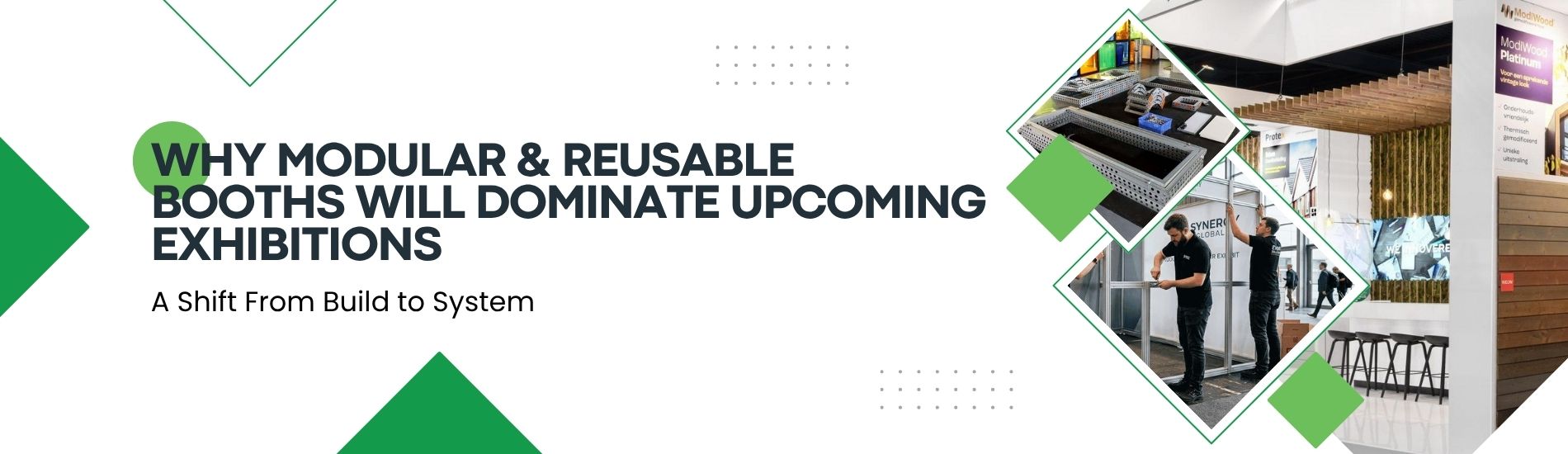
Why Modular & Reusable Booths Will Dominate Upcoming Exhibitions
Why Modular & Reusable Booths Will Dominate Upcoming Exhibitions
A Shift From Build to System
The concept of exhibition events in 2026 does not exist as a singular phenomenon anymore. It is becoming more of a cyclical process, where companies appear regularly in different cities, events, and demographics. Instead of creating a single event design once, businesses are opting to make booth designs that can be utilized repeatedly for different events.
This change has revealed a weakness in the current design approach to booths. Booths that are designed for a single event are not flexible enough to adapt to subsequent appearances. This trend is subtly shifting the emphasis from the visual appeal of a booth to its ability to repeat usage.
The Industry Is Moving Faster Than Its Built Models
Exhibitions nowadays do not happen in isolation. Exhibitions are elements of sustained brand presence.
As per UFI, the Global Association of the Exhibition Industry, the global exhibition scene not only has bounced back, but it has diversified across geography and formats in the post-2024 era. This means that the brands are not only putting their money into single or double high-impact events but are spending through the entire calendar year.
Yet, the majority of exhibition booth designs remain unchanged.
Conventional booth designs still adhere to event-centricity. These are designed, implemented, and dismantled within a very short span of time. This causes repeat effort, repeat expenditure, and repeated coordination.
The disparity is evident. The industry has expanded. Booth design has not.
Where Traditional Booth Strategies Fall Short
The problem lies not in the ability to design but rather the intent behind the designs.
Booths continue to be designed with one-off events in mind. There is no regard for the events that preceded and followed the current one.
Three recurring problems can be found here:
- Heavy utilisation of materials in structures that cannot be repurposed.
- Constantly redesigning and manufacturing the booths for every event.
- Non-uniform implementation between locations and vendors.
Studies indicate that much of the material used for exhibitions, particularly wooden constructions and printed materials, will no longer be part of the lifecycle after their breakdown. Not only is this an environmental concern, but it is also an economic inefficiency.
The second drawback is adaptability.
A stand built for one format seldom conforms to another. Any modification in the floor plan, traffic, or event necessitates either partial or total redesign.
This is where the traditional model starts breaking under scale.
What Modular Booths Change
Modular booths offer an entirely new method. They do not aim to provide a permanent structure but rather a flexible system.
Rather than designing a booth, brands develop a structure that can be reconfigured according to their needs.
This means that the same system can work differently depending on the nature of each event, such as using the large setup for big events or making it smaller for less crowded events.
The benefit is not only reuse but also flexibility.
Efficiency Is No Longer Optional
One of the important changes in 2026 is the emergence of efficiency within exhibitions.
The timing of setups is getting stricter. The venues are more organised. Logistics are increasingly complex, particularly for regional brands. Within such an environment, the presence of booths that require on-the-ground installation causes issues.
Modular displays solve this problem. Pre-designed elements speed up assembly and disassembly processes. What is more important is that they decrease dependency on unpredictable on-the-ground installations. They increase predictability.
Predictability is often much more valuable than visual intricacy at exhibitions.
Consistency Across Events Is Becoming Critical
Inconsistent presentation of the brand is yet another problem that can be noticed.
The reason for this inconsistency lies in the recreation of booths at each event. The differences are not so important on their own. However, as a whole, they weaken brand recognition.
Modular booths help solve this problem. There is a certain foundation that will remain intact throughout time. On the other hand, changes are allowed in relation to branding.
Sustainability Is Driving Structural Decisions
Sustainability within exhibition structures goes far beyond merely choosing materials. This trend is impacting booth design from its very core.
A structure that can be utilised at several events eliminates the creation of waste," starting from the manufacturing process and ending at disposal.
Modern industry standards, as mentioned in the Event Industry Council's guidelines, focus more on quantifiable results, including waste minimization and efficient lifecycle management, compared to the one-time choice of materials.
Modular booths fit in perfectly well with this approach. This design does not seek to improve the sustainability of one-off structures; it seeks to eliminate their need entirely.
The Shift Toward Asset-Based Thinking
One clear development in the year 2026 is how exhibitions are categorised by businesses. They have been recognized as assets instead of costs. It has altered the decision-making process.
The investments are judged not for one time use but through several events. Longevity is considered important. Flexibility is crucial. Designs are decided with longevity in mind.
It has brought an element of strategy to a domain where none was seen before.
What Defines an Effective Booth
From a practical standpoint, the concept of what constitutes an effective exhibition booth is taking shape. These include:
- The ability to adapt it for use on various occasions
- Elimination of unnecessary production costs and materials
- Consistency in usage regardless of location
- Simplifying the process of setting up and reducing logistical hazards
- Maximising the return on investment in the booth
If the above requirements are not met, such a solution would be considered less than efficient.
In Conclusion
The prevalence of booth modular and reusability is not based on the concept of trend, but on how the exhibition industry is developing, on its pragmatism, and on sustainability. The booths that will be successful won’t necessarily be better made, but those which were made once will be used wisely, since the future for exhibitions doesn’t lie in making more, but in sustainable systems.
Latest Blogs

© Copyright by FOUNTAINHEAD INTERNATIONAL B.V. || Designed and maintained by S2code