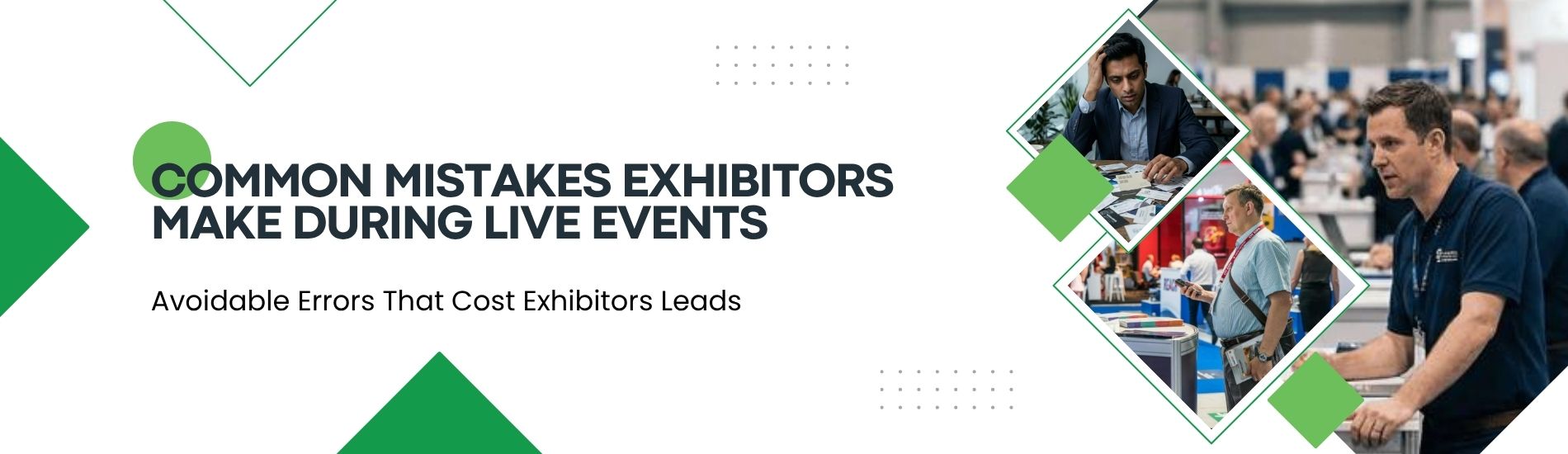
Common Mistakes Exhibitors Make During Live Events
Common Mistakes Exhibitors Make During Live Events
Exhibiting at a trade show is expensive enough that there's little margin for avoidable errors. Yet the same mistakes appear on show floors year after year, across industries and budget levels — not because exhibitors don't care, but because these issues are easy to overlook until they're actively costing leads.
Most of them aren't design flaws or bad luck. They're planning gaps that show up clearly once you know what to look for.
Exhibiting Without a Clear Objective
The most fundamental mistake happens before the show even starts: showing up without a defined goal. "Generate some leads" or "build brand awareness" sounds like an objective, but it isn't specific enough to guide decisions about stand design, staffing, or budget. Exhibitors with a defined target — a set number of qualified leads, pre-booked meetings, or product demonstrations — make sharper decisions at every stage, because every choice can be measured against that number.
Without this clarity, teams tend to default to "see what happens," which makes it almost impossible to judge whether the show was worth the investment afterwards.
Building a "Castle Wall" Booth
A surprisingly common design mistake is what the industry calls the castle-wall effect: furniture, counters, and displays lined up around the perimeter of the stand, unintentionally creating a barrier between the booth and the aisle. It looks organised on paper, but to a passing visitor it reads as closed off — somewhere you need an invitation to enter rather than somewhere you can simply walk in.
Open entry points, unobstructed sightlines, and a layout that pulls people toward the centre of the stand consistently outperform a defensive, boxed-in design.
Overloading the Booth With Text and Clutter
Trying to communicate everything a company does in one glance is one of the most persistent mistakes exhibitors make. Dense paragraphs of copy, oversized logos with no explanation of what the company actually does, and cluttered graphics all ask more of a passer-by than the few seconds they're willing to give. A booth should be legible at a glance — one clear message, readable from several metres away, with detail reserved for the conversation once someone has stopped.
Under-Preparing the Team
A well-designed stand can still underperform if the staff working it aren't ready. Common staffing mistakes include no agreed value proposition, no shared qualifying questions, and no understanding of what counts as a good lead. Some exhibitors also fall into "ambushing" — pouncing on every passer-by before they've had a chance to look — which tends to push visitors away rather than draw them in. A brief, well-prepared team consistently converts more conversations than a larger, unbriefed one.
Skipping Pre-Show Marketing
Waiting for the show floor to open before generating interest is a missed opportunity. Exhibitors who promote their presence beforehand — through email, LinkedIn, and personalised invitations to existing prospects — arrive with a head start, because some visitors will already be planning to stop by. Exhibitors who rely entirely on walk-in traffic are competing purely on booth visibility, which is a much harder game to win.
Underestimating the Full Budget
Many exhibitors budget for the stand build and the floor space, then get caught out by everything else: shipping, logistics, staff travel and accommodation, lead capture technology, and marketing materials. Replicating what a larger competitor is doing without accounting for the full cost picture often means compromising somewhere else — usually staffing or follow-up, which are exactly the areas that determine whether the show pays off.
Relying on Manual Lead Capture
Stacks of business cards and handwritten notes are still common, and they're one of the easiest ways for good leads to quietly disappear. Without a proper capture system — a badge scanner, a digital form, or a CRM-linked tool — context from the conversation gets lost by the time anyone gets around to following up, and the follow-up itself is often delayed by days.
Letting Leads Go Cold After the Show
This is the mistake with the biggest impact on ROI. Leads collected at a show have a short shelf life — interest fades quickly once the event ends, and a competitor who reaches out first often wins the next conversation by default. Exhibitors who treat follow-up as a "get to it next week" task routinely lose value they already paid for on the show floor.
Treating the Show as a One-Off Event Rather Than a Process
The final, broader mistake is treating each exhibition as an isolated event rather than part of an ongoing process. Without a post-show review — what worked, what didn't, which leads converted — the same design and planning mistakes tend to repeat at the next show, because there's no structured feedback loop to catch them.
Avoiding These Mistakes Starts With Planning, Not Budget
None of the mistakes above require a bigger budget to fix. They require clear goals set before the show, a layout designed to invite rather than block, a briefed and qualified staff, and a follow-up process that's ready to go before the event even opens.
Fountainhead International B.V. works with exhibitors to get the planning right from the earliest stages — stand design, layout, and logistics built around avoiding exactly these pitfalls. If your last show underperformed for reasons that felt avoidable in hindsight, we can help make sure the next one doesn't.
Latest Blogs
Nov 06,2026
How to Evaluate Exhibition Performance Before Planning Your...
Upcoming exhibitions , How To


© Copyright by FOUNTAINHEAD INTERNATIONAL B.V. || Designed and maintained by S2code