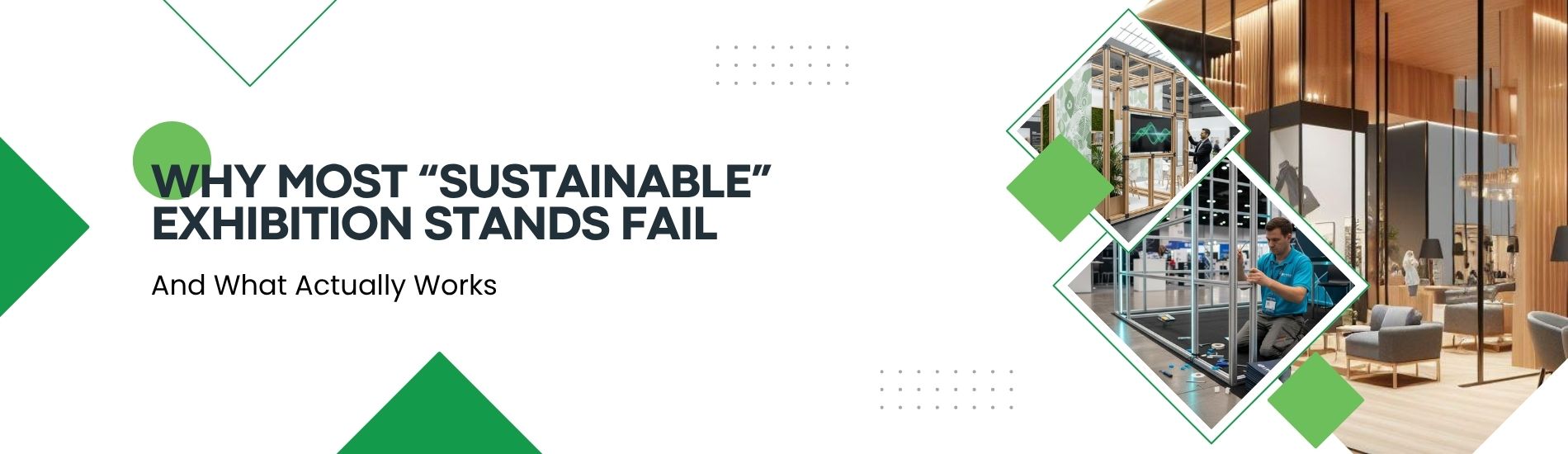
Why Most “Sustainable” Exhibition Stands Fail
Why Most “Sustainable” Exhibition Stands Fail
And What Actually Works
The exhibition industry is growing again. And it is growing fast.
According to the Global Association of the Exhibition Industry (UFI), over 32,000 exhibitions took place globally in 2024. But here is the catch. As the industry grows larger, its carbon footprint also increases. And though sustainability is the buzzword of the day, it is yet to be put into action.
Therefore, in 2026, it is no longer “Is your stand sustainable?” but “Does it actually hold up under scrutiny?”
The Industry Knows the Problem, But Execution Is Slower
Sustainability is now a key strategic focus in the exhibition industry. Industry barometers consistently rate it among the key concerns for both organizers and exhibitors.
But there is still room for growth.
Research and reports have indicated that although most stakeholders have recognised that sustainability is key, there is still much work in progress. Most exhibitors are still in transition.
This is because there is still sustainability in theory, but not necessarily in structure.
Where Most Exhibition Stands Go Wrong
The problem is not the absence of awareness. It is the process.
Most stands are still designed with a short-term focus. They are optimized for the event, not optimized for efficiency beyond the event. This leads to the use of high volumes of materials that are used once and then discarded.
Studies on waste management undertaken by the Global Association of the Exhibition Industry (UFI) show that there is considerable waste generated at exhibitions in the form of wood, packaging materials, and printed materials, which do not find their way back into the usage cycle.
The second problem is the timing.
Sustainability is brought into the process too late. By the time the material selection or the sustainability message is considered, the fundamental design decisions are already taken. At this point, the potential for real change is superficial.
This is why many stands are designed to be sustainable but fail to perform in a sustainable manner.
What Actually Works in 2026
Designing With Measurable Outcomes
One of the most important changes in the industry at the moment is the shift toward sustainable and measurable sustainability.
Exhibitors are now starting to measure the stands they build based on performance rather than perception. This includes waste, reuse, and overall impact on the environment.
The sustainability frameworks that govern the industry now recommend that brands quantify decisions rather than making assumptions. For instance, the Event Industry Council emphasises that new event strategies now incorporate measurable outcomes such as waste reduction, energy consumption, and emissions.
The shift is subtle but fundamental. Sustainability is no longer just about design; it’s now about business.
Smarter Systems Instead of Repeated Builds
Another noticeable shift is in the way stands are planned across multiple events.
Traditionally, brands have been created from scratch. However, with these trends, brands are creating systems that are dynamic. This means less production is required, which is efficient.
This also means costs are impacted.
It is believed that by embracing reusable models of exhibitions, brands can save money in the long run. In fact, it is believed that brands can save considerably by avoiding waste. What may seem like an additional investment is, in fact, a controlled cost.
Sustainability is, in fact, a byproduct.
Less Build, More Intent
There is also a noticeable change in the way of thinking.
Exhibition space is becoming more refined. Instead of filling space, there is a focus on clarity. The objective is no longer to build more, but to build what matters.
This results in:
- More focused space for visitors to navigate
- Less material usage without compromising the effect
- A clearer hierarchy of visuals within the stand
What’s interesting, though, is that these types of stands are actually performing better. They are easier to navigate, easier to understand, and more in line with how people are engaging in a high-density environment.
Why This Shift Is Becoming Critical
Sustainability is no longer an internal goal. It is an aspect that is noticed by those who attend.
Today’s visitors are more conscious of environmental practices, and it is easier to identify discrepancies. A stand that talks about sustainability but is highly dependent on disposable items is not coherent.
However, a highly efficient and organised stand can already convey credibility without having to say much.
This is when sustainability begins to affect perception. Not in terms of communication, but in terms of decisions made.
What Defines a Truly Sustainable Stand Today
Practically, the definition of a sustainable exhibition stand in 2026 is limited to the following principles:
- It is designed to be reused at multiple events.
- It generates minimal waste when disassembled and constructed.
- It has a thoughtful integration of the physical and digital.
- It has logistics and transportation efficiency in mind.
- It is judged in relation to outcomes, not assumptions.
This is the definition of the concept, and anything beyond this is considered incomplete.
In Conclusion
Sustainability in exhibition stands is not about adding the right elements at the end. Rather, it is about removing the wrong decisions at the beginning. It is about thinking beyond the event itself and designing with intent rather than excess.
Additionally, it is about aligning what your brand says with what your brand does. In the year 2026, sustainability in exhibition stands is no longer just a feature of the stand. Rather, it is a reflection of how intelligently the stand was designed in the first place.
Latest Blogs


© Copyright by FOUNTAINHEAD INTERNATIONAL B.V. || Designed and maintained by S2code