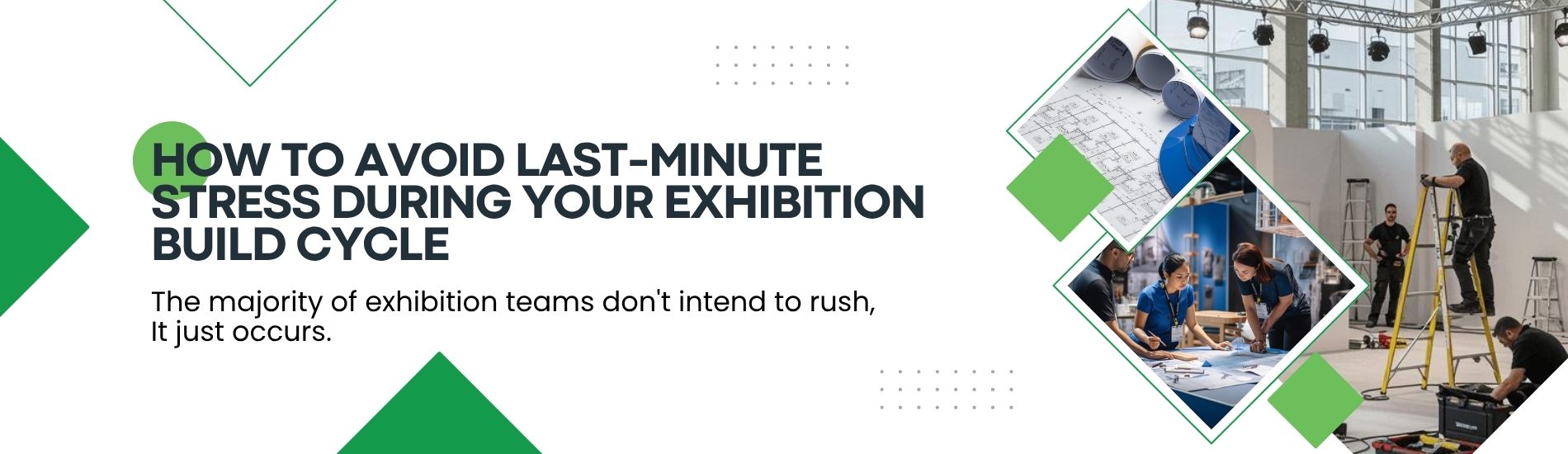
How to Avoid Last-Minute Stress During Your Exhibition Build Cycle
How to Avoid Last-Minute Stress During Your Exhibition Build Cycle
The majority of exhibition teams don't intend to rush. It just occurs.
According to recent insights from UFI – The Global Association of the Exhibition Industry, tight deadlines and difficulties with on-site coordination continue to rank among the top operational concerns for exhibitors and organisers worldwide. That delay does not cause the timetable to be extended in exhibitions with set timelines. It becomes compressed.
On the exhibition floor, what appears to be a last-minute issue is typically the consequence of hurried decisions, too optimistic timeframes, or misjudged dependencies. There won't be much space left to change direction by the time the project arrives at the location. The pressure you see on-site is simply the outcome of everything that happened before.
Exhibition Stress Doesn’t Start On-Site
Decisions that were postponed far earlier are typically the cause of what appears as chaos during installation. Finalising the design takes longer when the booth's goals are not defined. Production schedules are shortened when the design is postponed. Additionally, installation is often rushed when production declines.
This has an impact on more than just timetables in an exhibition setting. It affects teamwork, execution quality, and the final appearance of the brand on the floor. Time is not the true problem. It has to do with how and when that time is spent.
What Actually Triggers Last-Minute Chaos in Exhibition Builds
Exhibition projects have strict deadlines that cannot be compromised. Yet, the same pressure points continue to appear across builds.
Delayed Design Freeze
When made too close to production, even minor design modifications might cause fabrication schedules to be thrown off. Reprints, structural modifications, or material alterations are frequently the result of a little change in layout, branding, or messaging.
Late-stage design changes are not isolated in exhibition settings because manufacturing, logistics, and installation are closely intertwined. They have an impact on every step of the construction process. On-site, where time, money, and execution quality are already under strain, what appears to be a little adjustment on paper frequently becomes rushed adjustments.
Vendor Misalignment
On-site teams, logistics partners, printers, and fabricators all rely on one another. Execution is negatively impacted by late alignment. A delay at one stage creates a domino effect across the build.
Supply Chain Disruptions
One of the most unpredictable aspects of exhibition builds is still the availability of materials and logistics. Lighting components, structural elements, print substrates, and custom materials are often sourced from multiple vendors, sometimes from different geographical areas.
The impact is especially noticeable in exhibitions, even if more general industry data show that supply chain problems account for a sizable portion of project delays. Not only may a delayed shipment or a missing component impede progress, but it can even completely halt production or shorten installation schedules.
As a result, many last-minute on-site modifications arise from supply chain gaps that catch up with the build timetable, rather than design flaws.
Unrealistic Timelines
Planning based on best-case scenarios rather than real constraints often leads to compressed execution. What looks efficient on paper turns into pressure on-site.
What High-Performing Exhibition Teams Do Differently
Smooth delivery teams don't put in more effort at the end. At the beginning, they are making better choices.
They start with well-defined goals, making sure that each design and construction choice is in line with a specific goal. This reduces the need for later, unnecessary changes.
They impose an early design freeze, establishing a limit beyond which modifications are regulated rather than ongoing.
Additionally, they involve vendors early in the process to guarantee that dependencies, timeliness, and viability are taken care of before production starts.
The way they handle timelines is another significant distinction. They use buffers to account for real-world disturbances rather than striving for flawless execution.
Most significantly, they place a high priority on making decisions early on, eliminating uncertainty before it becomes an obstacle.
Building a No-Surprise Exhibition Execution Plan
Avoiding last-minute stress requires a system that minimises uncertainty at every stage.
- Start with backward planning from the show date. Map out key milestones such as design approval, production start, dispatch, and installation. This ensures every phase has a clear timeline.
- Shift to milestone-based tracking. Instead of relying on broad schedules, track progress through specific checkpoints. This makes it easier to identify and address delays early.
- Create parallel workflows wherever possible. Content, fabrication, and logistics don’t always need to wait on each other. Running them simultaneously can save critical time.
- Ensure real-time communication across teams and vendors. Faster decisions during planning reduce pressure during execution.
- Finally, include contingency buffers at every critical stage. In exhibitions, where deadlines cannot be moved, buffers are what protect the entire build from collapsing into last-minute chaos.
Plan Early, Execute Calmly
Last-minute stress in exhibition builds is not an accident. It’s a pattern.
It comes from delayed approvals, extended design phases, misaligned vendors, and timelines that ignore real-world constraints. By the time the team reaches the venue, the pressure is already built into the process.
The teams that stand out on the show floor are not the ones who manage stress better. They are the ones who prevent it.
When objectives are clear, designs are locked on time, vendors are aligned early, and timelines include buffers, execution becomes controlled instead of reactive.
In 2026, where exhibition builds are becoming more complex and timelines more rigid, this shift is not optional. It’s what separates a rushed setup from a confident, ready-to-open booth.
Latest Blogs

© Copyright by FOUNTAINHEAD INTERNATIONAL B.V. || Designed and maintained by S2code