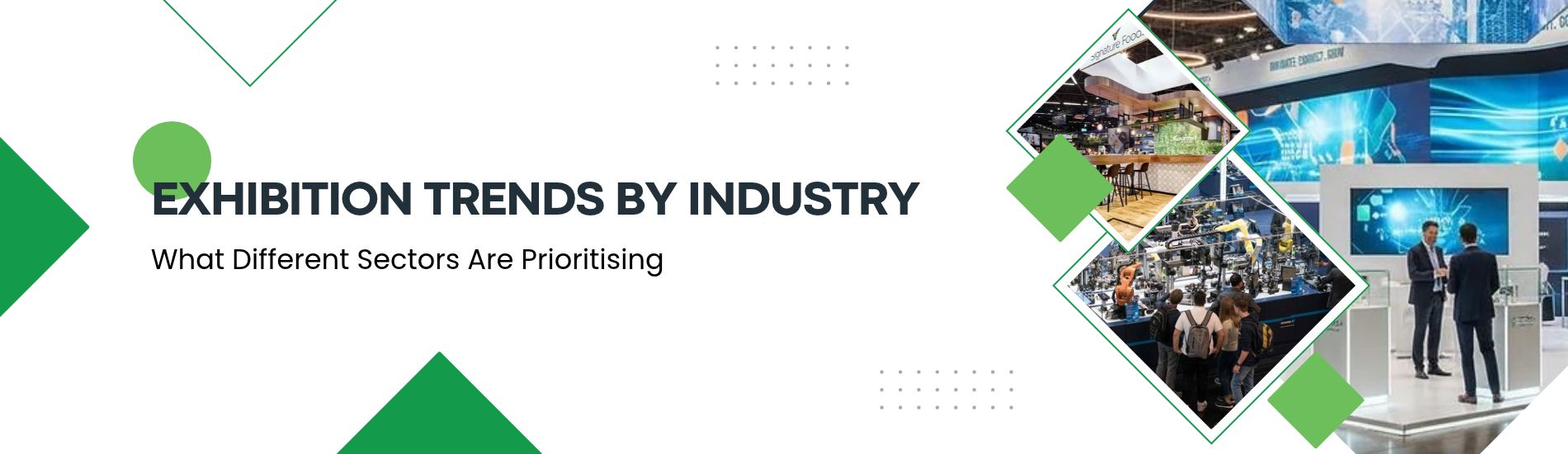
Exhibition Trends by Industry
Exhibition Trends by Industry: What Different Sectors Are Prioritising
Not every exhibitor is solving the same problem on the show floor. A pharmaceutical company navigating strict compliance rules has a very different brief to an aviation MRO supplier trying to demonstrate technical credibility to airline procurement teams, or a broadcast technology brand showing off the latest AI-driven production tools. Yet a handful of shared themes — sustainability, personalisation, and genuine human connection — are showing up across almost every sector, even as each industry applies them differently.
Here's how exhibition priorities are shaping up across the sectors most active on the European trade show circuit.
The Cross-Industry Baseline: Sustainability Is No Longer Optional
Regardless of sector, sustainability has moved from a nice-to-have to an expectation. Exhibitors across industries are shifting toward modular and reusable stand systems, recyclable and FSC-certified materials, energy-efficient LED lighting, and digital alternatives to printed brochures. Venues and show organisers are reinforcing this shift with their own environmental initiatives, from recycling points to stricter waste guidelines.
What differs by sector is how visibly this gets communicated. In pharma and life sciences, for example, visitors increasingly expect exhibitors to be able to speak openly and specifically about their sustainability practices, not just display a certification logo. In manufacturing and industrial sectors, the emphasis leans more toward the practical case — reusable rental exhibits and local production reducing freight and storage costs alongside the environmental benefit.
Aviation & MRO: Technical Credibility Over Spectacle
At shows like MRO Europe and MRO Americas, audiences are highly technical — airline maintenance engineers, fleet managers, procurement specialists, and OEM representatives who are evaluating suppliers on capability, not showmanship. Stands in this sector prioritise clear technical demonstration space, room for detailed one-to-one conversations, and messaging that gets to specifications and capability quickly rather than relying on abstract brand storytelling.
Hosted meeting areas matter more here than in many other sectors, since a large share of valuable conversations at aviation trade shows happen as scheduled, pre-booked meetings rather than casual walk-ups. A stand that balances an approachable, open layout with dedicated space for these structured discussions tends to outperform a purely visual design in this industry.
Pharma & Life Sciences: Compliance-Safe, Connection-Led Design
Pharmaceutical exhibitors operate under some of the strictest content and messaging regulations of any sector, which shapes stand design in specific ways. Hybrid content approaches — consistent messaging that works across in-person and digital formats — help maintain compliance while still allowing some flexibility across audiences and markets.
At the same time, industry analysis for 2026 points to a clear shift toward spaces that prioritise connection over complexity: comfortable areas for conversation, accessible seating, and open layouts that encourage visitors to stay rather than move quickly through a transactional interaction. In a sector where trust and long relationship cycles matter more than impulse decisions, a calmer, more hosted stand experience is increasingly seen as the more effective choice.
Broadcast, Media & Technology: Personalisation and Immersive Tech
At technology and broadcast-focused shows, exhibitors are leaning heavily into AI-driven personalisation and immersive formats — interactive touchscreens, live product simulations, augmented reality demonstrations, and digital configurators that let visitors tailor a demo to their own use case in real time. These sectors have the audience and the subject matter to make advanced tech activations feel native rather than gimmicky, and visitors increasingly expect that level of interactivity as standard.
Behavioural design — using an understanding of how people naturally move through a space to shape booth layout — is particularly relevant here, since technology stands often need to guide visitors through a sequence of demonstrations rather than a single static message.
Manufacturing & Industrial: Function First, Built to Travel
For manufacturing and industrial exhibitors, the priority tends to be functional demonstration space — room to show equipment, materials, or processes in action — combined with a growing emphasis on modular, reusable stand systems that can be reconfigured across multiple shows a year. This sector has been an early and consistent adopter of rental and modular exhibit systems, partly for sustainability reasons and partly because it simply makes financial sense for companies exhibiting at several regional and international shows annually.
Messaging in this sector still tends to favour clarity and specification over abstract brand narrative, echoing the same technical-credibility priority seen in aviation and MRO.
The Common Thread Across Every Sector
Despite these differences, a few priorities show up almost everywhere in 2026: sustainability communicated with genuine specifics rather than surface-level claims, a shift toward interactivity over passive display, and a growing recognition that comfortable, connection-led spaces often outperform purely spectacular ones. The sectors succeeding with this are the ones adapting these shared trends to their own audience, rather than copying a generic template that ignores who's actually walking the show floor.
Designing for Your Sector, Not a Generic Template
Exhibition trends set the direction, but the details that make a stand work always come down to the specific audience in that specific hall. What lands at a broadcast technology show would feel out of place at an aviation maintenance conference, and vice versa.
Fountainhead International B.V. designs and builds stands across multiple sectors and shows throughout the year, from aviation and MRO to broadcast, media, and technology events across Europe. If you want a stand built around what actually resonates with your industry's audience — not a one-size-fits-all approach — our design team can help you plan it.
Latest Blogs
Nov 06,2026
How to Evaluate Exhibition Performance Before Planning Your...
Upcoming exhibitions , How To


© Copyright by FOUNTAINHEAD INTERNATIONAL B.V. || Designed and maintained by S2code